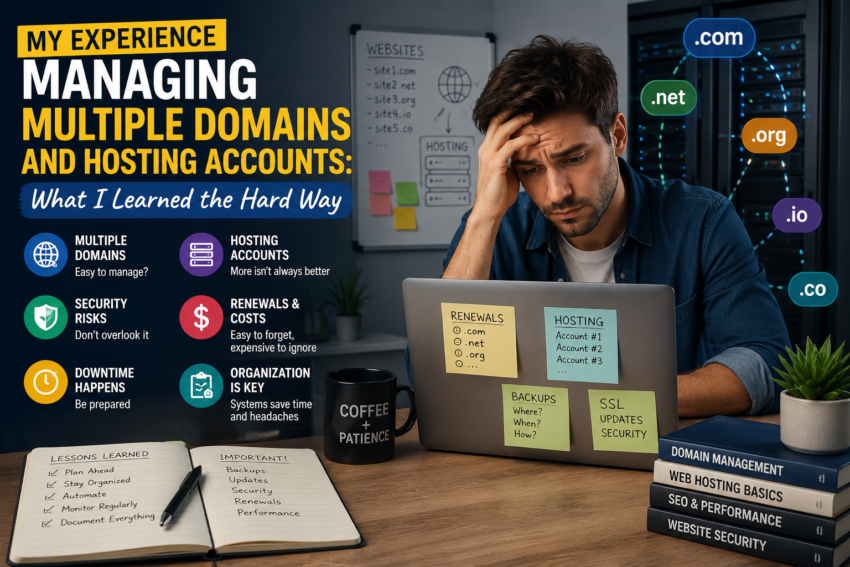
Managing one website sounds simple. Buy a domain, choose a hosting plan, install a website, and start publishing content. That was exactly what I thought when I launched my first site.
Things became much more complicated when I started managing multiple domains and hosting accounts.
At first, having several websites felt exciting. Each domain represented a new project and a new opportunity. But eventually, I realized that managing multiple websites requires organization, regular maintenance, and a willingness to learn from mistakes.
Here are the biggest lessons I learned along the way.
It Starts With Organization
My first mistake was assuming that I could remember everything.
I had several domain names, different hosting accounts, various login credentials, renewal dates, DNS settings, and website installations.
In the beginning, I kept track of most of it mentally.
That worked until the number of websites increased.
I eventually realized that domain management is partly an organizational task. I needed a clear record of important information, including domain expiration dates, hosting providers, DNS settings, renewal status, and website purpose.
Once I started organizing this information, managing my websites became much easier.
Domain Expiration Can Become a Serious Problem
One of the most important lessons I learned was never to ignore domain expiration dates.
When managing several domains, it is easy to overlook an email or forget when a particular domain needs to be renewed.
I learned to check expiration dates regularly and enable automatic renewal when appropriate.
A domain name is often the foundation of an entire website, so losing control of it can create much bigger problems than simply missing a reminder.
Now I treat domain renewal as something that deserves regular attention.
Different Hosting Accounts Create Different Challenges
Managing multiple hosting accounts taught me another lesson: not every hosting provider works the same way.
One provider might offer a familiar control panel, while another uses a completely different interface.
Features, backup systems, resource limits, DNS management, support options, and pricing can also vary.
At first, switching between different systems was frustrating.
Eventually, I learned to focus on the fundamentals rather than memorizing every interface.
I always want to know where the important settings are, how to access files, how backups work, and how to contact support.
Cheap Hosting Was Not Always the Best Choice
Cost was another factor I learned to consider carefully.
When I started managing multiple websites, choosing inexpensive hosting plans seemed like an easy way to control expenses.
However, price is only one part of the equation.
A low-cost plan may have resource limitations that become noticeable as a website grows.
Slow performance, limited storage, restricted databases, or insufficient server resources can eventually affect the experience of managing a site.
I learned that the right hosting plan should be based on the actual needs of a website rather than simply the lowest advertised price.
Backups Became a Priority
One of my biggest lessons involved backups.
It is easy to assume that because a hosting provider offers backups, everything is automatically safe.
I learned to think about backups more carefully.
A backup is valuable only if it can actually be restored when needed.
Today, I pay more attention to whether backups exist, how frequently they are created, how long they are retained, and how restoration works.
For important websites, maintaining an additional backup can provide another layer of protection.
DNS Records Used to Confuse Me
Domain Name System settings were probably one of the most confusing parts of managing multiple websites.
At first, terms such as A records, CNAME records, MX records, and nameservers seemed unnecessarily technical.
Eventually, I understood that DNS is essentially responsible for directing domain-related traffic to the appropriate services.
Once I understood the basic concepts, making changes became much less intimidating.
I also learned an important rule: do not change DNS settings without understanding what the change is supposed to accomplish.
A small mistake can make a website or email service temporarily unavailable.
Email Requires Extra Attention
Managing domains also introduced me to another issue: email configuration.
A domain may be used not only for a website but also for email.
That means DNS settings can affect both services.
I learned to be particularly careful when moving websites between hosting providers because changing nameservers or DNS records without planning can affect email delivery.
Whenever I migrate a domain, I now check both website and email requirements before making changes.
Website Migration Is More Than Moving Files
I have also learned that moving a website to another host involves more than copying files.
A migration can involve:
- Website files
- Databases
- DNS records
- SSL certificates
- Email settings
- Configuration files
- Domain settings
- Database credentials
The first time I moved a website, I underestimated how many small details could be involved.
Now I create a checklist before beginning a migration.
That simple step has made the process much less stressful.
Security Cannot Be Ignored
Managing multiple websites also means managing multiple security risks.
I learned to keep software updated, use strong passwords, enable available security features, and monitor websites for unusual activity.
The more websites I managed, the more important this became.
A problem affecting one website might be manageable, but dealing with security issues across several websites can consume significant time.
I Learned to Simplify
Perhaps the most valuable lesson was that more websites do not automatically mean better results.
Every additional domain creates another responsibility.
There are renewals to track, websites to update, backups to monitor, security issues to consider, and hosting resources to manage.
Eventually, I started asking whether every website genuinely needed to exist.
Removing unnecessary complexity made the remaining projects easier to manage.
Final Thoughts
Managing multiple domains and hosting accounts has taught me lessons that I would not have learned from running a single website.
I learned to organize domain information, monitor renewal dates, understand DNS basics, maintain reliable backups, plan migrations carefully, and choose hosting based on actual requirements rather than price alone.
Most importantly, I learned that website management is an ongoing responsibility.
A domain may be purchased in a few minutes, and a hosting account can be activated quickly, but keeping a website reliable requires consistent attention.
The biggest lesson I learned the hard way is that good website management is less about doing everything yourself and more about knowing what needs to be monitored, documented, protected, and maintained.
Once I stopped treating domains and hosting as things I could simply set up and forget, managing multiple websites became much more organized—and considerably less stressful.