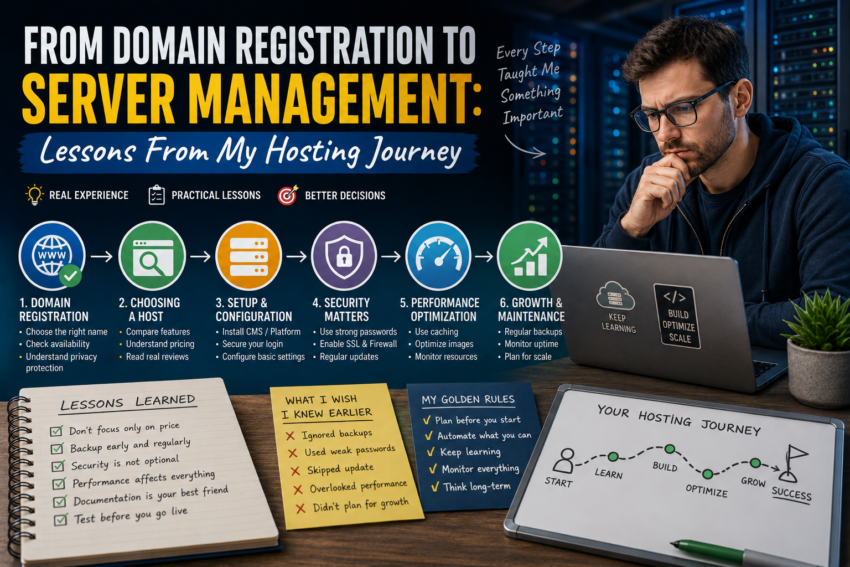
When I registered my first domain, I thought I was taking the biggest step toward building a website. I chose a name, completed the registration process, purchased a hosting plan, and connected the domain.
At the time, I believed that most of the technical work was handled by the hosting provider.
Years later, I realize that domain registration was only the beginning.
My journey eventually introduced me to DNS, hosting configurations, backups, migrations, server resources, security, and countless small details that are easy to overlook when managing websites.
Here are the most important lessons I learned along the way.
The First Domain Felt Like a Big Achievement
Registering my first domain was surprisingly exciting.
It was more than buying a web address. It felt like creating a permanent home for an idea.
I immediately started thinking about the website design, content, and features.
What I did not think about enough was what would happen after registration.
I quickly learned that owning a domain and having a functioning website are two different things.
The domain needs to point somewhere, and that “somewhere” is usually a hosting environment.
That was my introduction to the relationship between domains and hosting.
Understanding DNS Changed Everything
DNS was one of the first technical concepts that confused me.
Nameservers, A records, CNAME records, MX records, and propagation seemed complicated.
Eventually, I understood the basic idea: DNS helps direct domain-related requests to the appropriate servers and services.
Once I understood that, domain management became much less intimidating.
I also learned an important lesson: never change DNS settings casually.
Before making significant changes, I now record the existing configuration and make sure I understand what the new settings are supposed to accomplish.
Hosting Is More Than Storage
At first, I thought web hosting was simply a place to store website files.
That description is technically useful but incomplete.
Hosting can involve server resources, databases, email services, SSL certificates, backups, security tools, control panels, and many other components.
As my websites became more complex, I started paying more attention to available CPU, memory, storage, bandwidth, and other resource considerations.
A hosting plan that works well for a small website may not be suitable for a busier or more demanding project.
I Learned Not to Choose Hosting Based Only on Price
Price was one of my biggest considerations when I started.
I wanted to minimize expenses, so inexpensive hosting plans seemed attractive.
Over time, I realized that the cheapest option is not always the most practical.
Performance, reliability, support, resource limits, backup options, and scalability can be just as important as the monthly price.
I began evaluating hosting according to what each website actually needed.
That change helped me make better decisions.
Server Management Was a Different Level
Eventually, I became interested in managing servers more directly.
This was a major change from using a standard shared hosting control panel.
Server management introduced me to concepts such as operating system updates, server configuration, resource monitoring, firewall settings, logs, and service management.
It was more complicated, but it also gave me greater control.
I learned that greater control comes with greater responsibility.
When a managed hosting provider handles many technical tasks, there is less for the website owner to maintain.
When managing a server yourself, those responsibilities do not disappear.
They become yours.
Backups Became Non-Negotiable
The longer I managed websites, the more important backups became.
I learned that a backup is not useful simply because it exists.
You also need to know whether it can be restored successfully.
I started paying attention to backup frequency, storage locations, retention periods, and restoration procedures.
For important websites, having more than one recovery option can provide additional peace of mind.
Server Monitoring Taught Me to Be Proactive
One of the biggest differences between basic hosting and server management was learning to monitor resources.
A website can appear perfectly normal to a visitor while the server is experiencing problems behind the scenes.
Monitoring can help identify unusual CPU usage, memory pressure, storage issues, or other performance concerns.
Instead of waiting for users to report a problem, I learned to look for warning signs.
That proactive approach became an important part of my workflow.
Security Became a Daily Consideration
Managing websites also changed how I thought about security.
Keeping software updated, using strong authentication, limiting unnecessary services, monitoring logs, and maintaining backups became part of routine maintenance.
I learned that security is not a single feature that can simply be turned on.
It is an ongoing process.
The more websites and services I managed, the more important this mindset became.
Website Migration Taught Me to Plan
Moving a website between hosting environments was another valuable lesson.
A migration can involve much more than transferring website files.
There may be databases, DNS records, SSL certificates, email configurations, application settings, and other dependencies.
I learned to create a migration checklist and test the new environment before making major changes to the live website.
Planning reduced the number of surprises.
Documentation Saved Me Time
Another habit I developed was documenting important server and domain changes.
I record things such as configuration changes, migration steps, DNS updates, and important account information.
This becomes especially useful months later.
Without documentation, troubleshooting often turns into a memory exercise.
With documentation, I can review what changed and understand why a problem might have appeared.
Final Thoughts
My hosting journey started with something very simple: registering a domain.
From there, I gradually learned about hosting, DNS, backups, server resources, security, monitoring, and migrations.
Each stage taught me something different.
The most important lesson is that website infrastructure should not be treated as something that can be configured once and forgotten.
Domains need renewal management.
Hosting needs monitoring.
Websites need updates and backups.
Servers need security and maintenance.
And important changes should be planned carefully.
Looking back, I realize that my biggest growth came from understanding the responsibilities behind keeping a website online.