When I first started managing websites, I thought the hardest part would be creating good content and attracting visitors. I quickly discovered that there was another side of website ownership that received much less attention: managing domains, hosting, DNS, backups, security, and everything else that keeps a website running.
Over the years, I made several mistakes in these areas. Fortunately, most of them became valuable lessons.
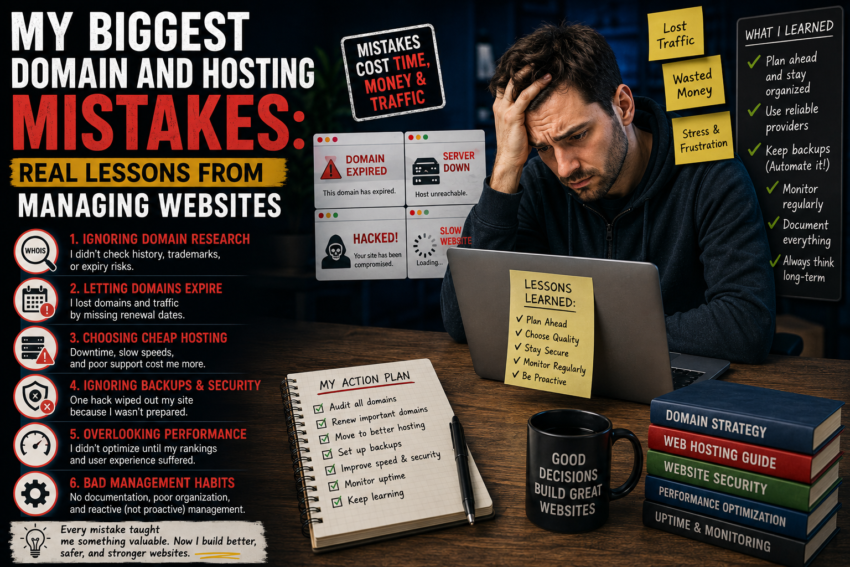
Here are some of the biggest mistakes I made and what they taught me about managing websites more responsibly.
I Thought Domain Registration Was a One-Time Task
My first mistake was thinking that registering a domain meant I could forget about it.
Once the domain was connected to my website, I focused almost entirely on publishing content.
I eventually realized that domains require ongoing management.
Renewal dates matter. Contact information matters. DNS settings matter. Account security matters.
A domain can become one of the most valuable assets associated with a website, especially after years of building content and reputation around it.
Today, I keep track of domain expiration dates and use automatic renewal when appropriate.
I Registered Domains Without a Clear Plan
Another mistake was buying domains simply because I liked their names.
A domain can look attractive without having a practical purpose.
Over time, I accumulated several domains that had no clear project behind them.
Each one created another renewal date and another item to monitor.
Eventually, I became more selective.
Before registering a new domain, I now ask myself whether I have a realistic use for it.
That simple question has prevented unnecessary purchases and reduced my administrative workload.
I Chose Hosting Based Too Much on Price
When I was starting out, price was one of my main concerns.
I naturally searched for affordable hosting plans.
The problem was that the cheapest option was not always the best fit for my websites.
As projects grew, resource limits and performance became more important.
I learned that hosting should be evaluated based on factors such as resources, reliability, support, backups, security features, scalability, and the needs of the specific website.
Saving a small amount each month is not worthwhile if the hosting environment creates ongoing problems.
I Assumed Hosting Backups Were Enough
Backups were another area where I learned the hard way.
I assumed that if my hosting provider advertised backups, I did not need to think much about them.
Eventually, I realized that backup policies can differ considerably.
Questions such as how often backups are created, how long they are retained, where they are stored, and how restoration works are important.
I also learned that having an independent backup can provide additional protection.
The experience changed my attitude completely.
Backups are not something I want to think about after a problem occurs.
I Changed DNS Too Quickly
DNS was probably one of the most frustrating parts of website management when I was learning.
I once made a change without fully considering its consequences.
The website configuration did not behave as expected, and I had to spend time figuring out what had changed.
That experience taught me to slow down.
Before modifying important DNS records, I now document the existing configuration and make sure I understand the purpose of the change.
This is especially important when moving a domain between hosting providers.
I Forgot About Email During a Migration
One of my more memorable lessons involved email.
I was focused on moving a website and did not give enough attention to the domain’s email configuration.
Later, I realized that website DNS and email settings can be closely connected.
A hosting migration is therefore not simply about moving website files.
Before making changes today, I check whether the domain is being used for email and identify the relevant DNS records.
That small checklist has prevented unnecessary surprises.
I Underestimated Website Migrations
My first website migration was much more complicated than expected.
I thought I would copy the files, move the database, change the DNS settings, and be finished.
In reality, several other details could matter.
These can include:
- Database configuration
- SSL certificates
- DNS records
- Email settings
- Server versions
- Application dependencies
- File permissions
- Backup and restoration procedures
I eventually learned that a migration should be treated as a project rather than a quick technical task.
I Delayed Software Updates
Another mistake was delaying updates because a website appeared to be working normally.
I thought, “If nothing is broken, why change it?”
That mindset can create unnecessary security and compatibility risks.
I learned to keep important website software updated and to make sure I have a recent backup before performing major changes.
Updates are much easier to manage when they are part of a regular maintenance routine.
I Did Not Document Enough
Perhaps the simplest mistake was failing to document changes.
When managing only one website, it is easy to remember what you changed.
With multiple websites, memory becomes unreliable.
I now keep notes about important DNS changes, hosting migrations, configurations, and other technical decisions.
Documentation saves time when something goes wrong months later.
Instead of wondering what changed, I can review my notes.
I Learned That Reliability Requires Preparation
All of these mistakes taught me the same basic lesson.
A website should not be managed only when something breaks.
Reliable website management involves preparation.
That includes monitoring domain renewals, maintaining backups, keeping software updated, protecting accounts, understanding DNS, and choosing appropriate hosting.
None of these tasks are particularly exciting, but they become extremely important when something unexpected happens.